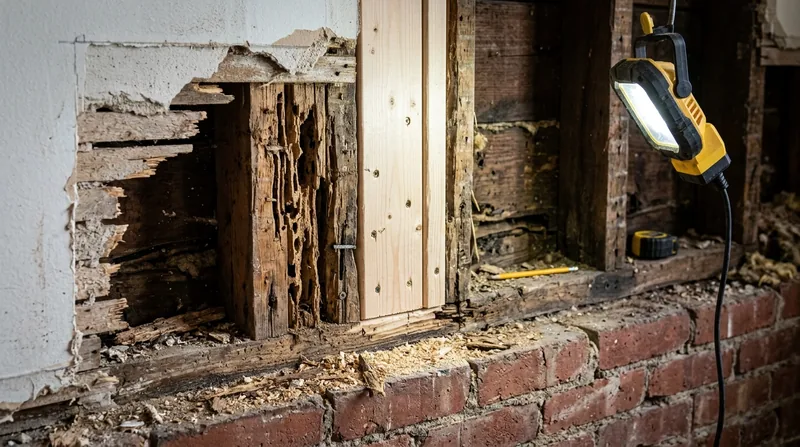




Eastern subterranean termites and carpenter ants find their way into Springfield's oldest homes through damp basement sills and rim joists, leaving behind hollowed framing that must be replaced. After your pest inspection and exterminator's treatment, the structural damage remains, and wood-eating insects leave a trail of compromised studs, sill plates, subfloor sections, and trim that pose real safety and cost issues if left unaddressed. Termite damage repair in Springfield means removing the damaged wood and installing new framing to restore full structural integrity, working from your pest report and building code requirements. The Connecticut River valley's cold winters, freeze-thaw cycles, and humid summers keep many older foundations damp at the sill, making termite and carpenter ant damage a routine repair across the Victorian homes of McKnight, the three-deckers of Six Corners and Liberty Heights, and the brick colonials of Longmeadow and Wilbraham. We replace hollowed studs, compromised sills, damaged subfloor, and rotted trim, restoring the wood structure so your home stands solid again. See our wood rot and dry rot repair page for related moisture-driven damage we address.
Why Termite and Carpenter Ant Damage Matters in Springfield Homes
Termite colonies work silently through wood, hollowing out load-bearing studs and floor joists from the inside while the surface may look intact. Carpenter ants tunnel through both wet and dry wood, leaving sawdust and voids that weaken framing over months or years. In Springfield's older homes, where sill plates sit directly on damp fieldstone or brick foundations, termites and ants find ideal conditions. Once the pest control treatment ends, the structural damage persists, and every season of settling and movement stresses the compromised wood further.
- Hollowed studs lose load-bearing capacity and can fail under roof or floor load.
- Damaged rim joists and sill plates allow floors to sag and create gaps at the foundation line.
- Compromised subfloor sections create soft spots, squeaking, and uneven floor height.
- Infested trim and fascia invite further moisture infiltration and secondary wood rot.
- Structural failure over time puts interior walls, ceilings, and personal safety at risk.
Replacing the damaged wood promptly stops the cascade of secondary problems and restores the home's structural soundness.
Key info: In Springfield and surrounding towns, eastern subterranean termites are most active in the Connecticut River valley lowlands where water tables are high and soil stays damp. A pest inspection report from a licensed exterminator is your blueprint for determining which wood must be replaced and which can be left in place.
For more information on how moisture and pests interact in your home's structure, see the Oregon State University guide to carpenter ants and wood damage, which covers detection and structural assessment principles that apply across North America.
How We Repair Termite Damage: Our Process in Springfield Homes
We start with your pest inspection report and a site visit to assess which wood must come out and which framing can stay. We remove damaged studs, sill sections, subfloor, and trim, then install new pressure-treated or solid wood to match the original structure and meet current building code. We work carefully around existing plumbing, electrical, and HVAC runs, and we restore the home to full occupancy as quickly as the scope allows. This is not a cosmetic job, it is structural repair that restores load paths and eliminates soft spots and settlement.
- We examine the damage and determine which wood sections must be replaced based on structural integrity and code requirements.
- We carefully remove compromised studs, sill plates, rim joists, and subfloor sections without disturbing sound framing nearby.
- We install new framing using pressure-treated lumber or solid wood, sistering new joists alongside existing ones where possible to preserve headroom.
- We restore trim, fascia, and exterior casing to match the original profile and protect the new wood from weather.
- We document the repair with photos and a written scope so you can file an insurance claim if your policy covers pest damage.
The goal is to restore full structural integrity so your home is safe and sound for decades to come.
Local example: A 1920s colonial in West Springfield with termite damage to the sill plate and rim joist needed the damaged wood removed and a new pressure-treated sill installed. We sistered new floor joists alongside the existing ones to restore the floor to level and prevent further settlement. The work took five days and restored full structural support without removing or replacing the entire foundation.
For more detail on how we approach structural framing repairs, see our framing and structural carpentry page.
Termite and Carpenter Ant Damage Repair Methods
| Repair Method | Description | Best For |
|---|---|---|
| Stud and Framing Replacement | Remove hollowed wall studs or floor joists and install new pressure-treated or solid wood members, sistering where possible to preserve existing framing. | Load-bearing walls, floor joists, and rim joists where structural capacity is compromised. |
| Sill Plate Replacement | Remove damaged sill sections sitting on the foundation and install new pressure-treated wood, ensuring proper bearing and drainage. | Termite and ant damage at the foundation line where moisture and pests converge. |
| Subfloor Section Repair | Remove soft or hollowed subfloor and install new plywood or solid wood decking, restoring floor height and eliminating soft spots. | Basement rim areas and first-floor subfloor where termites hollow wood from below. |
| Trim and Fascia Replacement | Remove damaged exterior trim, fascia, and casing and install new wood or composite material to match original profile and protect framing. | Exterior wood trim and soffits where insects and moisture create entry points for secondary damage. |
| Structural Inspection and Sistering | Assess damage depth, install new joists or studs alongside compromised ones using bolts and blocking to share load without full replacement. | Partial damage where sound framing remains and headroom or access constraints favor repair over full member replacement. |
Termite Damage Repair Cost in Springfield: What to Expect
Termite damage repair cost in Springfield typically starts at $1,200 for small, localized damage such as a damaged sill section or a few compromised studs in a non-load-bearing wall. Larger jobs involving multiple joists, full rim joist replacement, or extensive subfloor repair run $3,500 to $8,000 or more, depending on the extent of damage, access difficulty, and whether the work requires a structural permit. The biggest cost drivers are the amount of wood that must be removed, the complexity of working around existing systems (plumbing, electrical, HVAC), and whether the repair is structural (load-bearing) or non-structural.
Getting two or three estimates from local carpenters gives you a realistic picture of the scope and helps you compare approach and pricing. Make sure each estimate includes the extent of damage found, the wood to be replaced, any structural sistering or reinforcement, and a timeline. Many insurance policies cover termite damage if you have a current pest inspection report and act promptly to repair the wood.
See our full pricing overview for detailed breakdowns and factors that affect cost, or call us at (413) 288-3982 for a free, no-obligation estimate on your specific damage.
Termite Damage Repair Near Me: What Springfield Homeowners Should Know When Hiring
When you are ready to hire a carpentry contractor for termite or carpenter ant damage repair, ask to see proof of insurance coverage and verify that the contractor is fully insured for both liability and workers compensation. Get multiple estimates in writing, each with a clear scope of work, materials, timeline, and price. Ask for references from recent jobs in Springfield or nearby towns, and follow up by calling at least two to ask about the quality of the repair and whether the contractor showed up on time and kept the site clean. If your repair involves structural work such as removing or replacing a load-bearing wall or major joist sections, confirm that the contractor understands local building code and can coordinate with the Springfield Building Department if a permit is required.
- Request proof of full insurance coverage and ask to see the certificate of insurance before work begins.
- Get estimates in writing with detailed scope, materials, timeline, and labor cost so you can compare fairly.
- Call references from jobs completed in the past 12 months to verify quality, professionalism, and on-time completion.
- Ask whether the contractor has experience with your home's era and building type, Victorian, three-decker, or 1950s cape.
- Clarify who coordinates with the building department if a permit is needed for structural or load-bearing repairs.
- Confirm that the contractor will provide photos and documentation of the repair for your insurance claim.
Hiring a local contractor who knows Springfield's building stock and climate saves time and money because they understand the specific failure modes in older homes and how to address them correctly.
Ready to move forward? Contact us for a free estimate or call (413) 288-3982 to discuss your termite or carpenter ant damage and get a realistic timeline and price.
Termite Damage Repair in Springfield: Pricing Guide
| Service | Price | Details |
|---|---|---|
| Small localized damage (single stud, short sill section, minor subfloor) | Starting at $1,200 | Removal and replacement of one to three wood members, minimal access complexity, non-load-bearing location |
| Moderate structural damage (rim joist, multiple floor joists, or sill replacement) | Starting at $3,500 | Removal and sistering of two to four joists, sill plate repair, load-bearing assessment, includes structural documentation |
| Extensive termite or carpenter ant damage (multiple walls, subfloor sections, or foundation-line repair) | Starting at $6,000 | Large-scale removal and replacement, multiple structural members, possible permit coordination, full structural restoration |
| Complex or multi-area job (entire sill line, multiple rooms, or heritage home considerations) | On estimate | Site assessment required to determine full scope, material costs, and structural engineering or permit needs before pricing |
| Travel | Included | No separate call-out or mileage fee for Springfield and surrounding service area towns |
| Free estimate | No obligation | Response within 24 hours at (413) 288-3982, includes site walk-through and written scope with realistic pricing |
Indicative pricing, the exact cost depends on square footage, finish, and site access. Free personalized estimate within 24h at (413) 288-3982.


