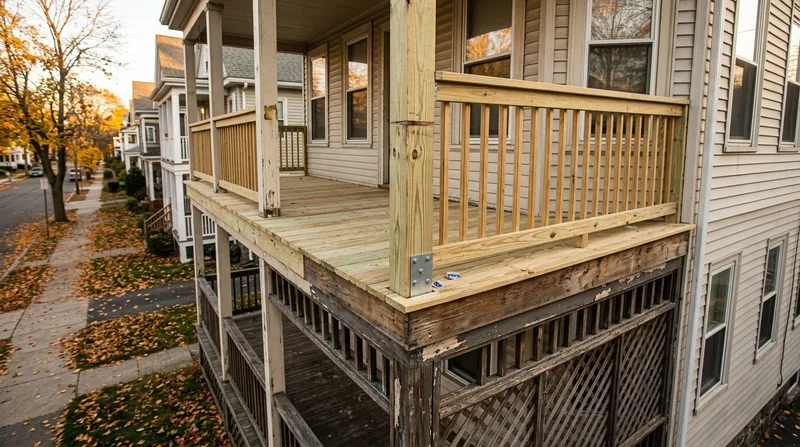




Springfield's Victorian wraparound porches, three-decker stacked decks, and colonial-era exterior platforms face relentless pressure from New England winters and humid summers. Snow load, freeze-thaw cycles, and ice dams push moisture into framing; wet seasons and river-valley humidity keep wood damp year-round. Carpenter ants, powderpost beetles, and eastern subterranean termites exploit that moisture. The result: rotted posts, soft treads, failing railings, and structural movement that makes outdoor spaces unsafe. Deck and porch repair in Springfield means identifying what's salvageable, replacing what's failed, and anchoring your outdoor structure solid again. We work from the wood itself, not a script. If the joist takes a probe, we tell you what it means and what it costs to fix.
Why Deck and Porch Repair Matters in Springfield's Historic Neighborhoods
Springfield's architectural stock depends on its outdoor wood. McKnight's Queen Annes and Stick-style homes sit behind wraparound porches that carry decades of snow and ice. The three-deckers in Six Corners, the South End, and Indian Orchard have open porches stacked three stories high, each one exposed to the same freeze-thaw punishment. Forest Park's colonials and the Sixteen Acres ranches have deck structures built when lumber was cheaper and replacement was easier than repair. Today, deferred maintenance on these platforms creates real hazards: soft treads, loose railings, rotted posts that shift under load.
Moisture is the engine. Fieldstone and brick foundations over damp basements mean rim joists and sill plates live in a wet microclimate. Ice dams push meltwater into fascia and wall cavities. Humid summers keep everything damp. Wood that stays wet becomes food for insects and fungi. A post that looks solid on the surface may be punky inside. A tread that flexes more than it should signals joist decay. A railing that moves is a liability.
- We inspect posts, beams, joists, and railings for wood rot, insect damage, and structural movement.
- We distinguish between repairs that restore safety and replacements that are the honest answer.
- We obtain permits where required for structural work and coordinate with your local building department.
- We document damage for insurance claims, helping you understand what you have and what it will cost to restore.
- We work with the wood: sister joists where the core is sound, replace where decay is deep.
A solid porch or deck keeps your home dry, your family safe, and your property value intact.
Key info: Springfield's 2011 tornado damaged rooflines and porch structures across Forest Park, Six Corners, and Sixteen Acres. Many homes had porches rebuilt then. If yours was among them, inspect the new framing now for any settling, movement, or soft wood from water entry during construction or in the years since.
For more on the structural issues that underlie porch and deck failure, see our guide to wood rot and dry rot repair in Springfield.
How We Repair Decks and Porches: From Inspection to Solid Footing
The work starts with understanding what you have. We walk the structure, probe critical joints and bearing points, check for movement and water entry, and look at what the foundation is doing underneath. A porch that sags slightly may have settled normally; one that sags on one side or shows cracking in the rim joist is telling you the foundation is moving or the framing is failing. We photograph, measure, and explain what we see before we quote.
From there, repair follows a clear logic. If the post is sound at the base but soft at the top from weather exposure, we replace the top section and sister it to the existing base. If the joist is punky but the rim is solid, we sister a new joist alongside the old one, tying them together to carry the load. If the wood is too far gone, we replace it in kind, matching species and dimension and tying it into the existing structure so the porch moves as one unit.
Railings, treads, and stairs follow the same principle: repair what's safe to repair, replace what's failed. A baluster that's split but not moving can be reinforced. A tread that's cupped but not soft can stay. A railing that shifts in its posts needs new posts or new bolts, depending on what the inspection finds.
- We begin with a detailed inspection and written scope, explaining what we find and why we recommend each step.
- We obtain a free estimate that breaks down labor, materials, and timeline so you know what the work costs and how long it takes.
- We pull any required permits before we start, coordinating with Springfield's building department or your town's equivalent.
- We work with existing framing whenever possible, sistering joists, replacing individual boards, or reinforcing posts rather than tearing out sound wood.
- We match materials: pressure-treated lumber for below-grade work, Douglas fir or redwood for exposed posts and railings, finish-grade boards for visible surfaces.
- We test the structure when we're done, checking for movement, racking, or flex that signals incomplete work.
The result is a porch or deck that's safe, solid, and built to last another generation.
Local example: A Victorian home in Longmeadow had a wraparound porch with corner posts that were soft from ground contact. We replaced the lower 18 inches of each post, sistered them to the existing upper sections, and installed new flashing to keep water out. The porch stayed in place, the railings held, and the homeowner kept the original character of the house. Total time: four days. No foundation work needed.
See our full approach to structural and framing carpentry for more on how we handle load-bearing elements.
Repair Methods: What We Use and Why
| Approach | Description | Best for |
|---|---|---|
| Sistering | Fastening a new joist, post, or beam alongside an existing one to share load and restore strength. | Joists or posts that are sound in structure but weakened by decay or insect damage in the outer wood. |
| Post or Board Replacement | Removing the failed piece and installing new pressure-treated or exterior-grade lumber in its place, tied to existing framing. | Posts, treads, or rim joists that are too far gone to repair or too soft to carry load safely. |
| Partial Replacement with Flashing | Replacing only the damaged section of a post or beam and installing new flashing or trim to stop water entry. | Posts or beams with decay at ground line or water-exposed joints, where the upper section is sound. |
| Railing and Baluster Repair | Reinforcing or replacing balusters, newel posts, and rail sections to restore safety and appearance. | Railings that are loose, split, or missing balusters, or that don't meet current code spacing requirements. |
| Stair Tread and Stringer Repair | Replacing treads, risers, or stringers, or sistering new stringers to existing ones to restore structural support. | Stairs that are soft, cupped, cracked, or that move or flex underfoot. |
Deck and Porch Repair Cost in Springfield: What to Expect
Cost depends on what the wood tells us. A simple repair, like replacing a single rotted post or sistering a joist, starts at $900 to $1,500 and includes the material, labor, and fasteners. A more complex job, like a full rim joist replacement or multiple posts on a three-decker porch, typically runs $2,500 to $5,000 or more. A complete structural rebuild of a large porch or deck can exceed that range and requires an on-site estimate.
What moves the price up or down: the size and complexity of the structure, how much wood is actually failed versus sound, whether the foundation is stable or needs attention, whether the work requires permits and inspections, and how accessible the damage is. A porch with a concrete pad and good drainage costs less to repair than one on a fieldstone foundation with standing water. A deck attached to a rim joist that's in good shape costs less than one where the attachment point is rotted and the house band is soft.
We always recommend getting 2 to 3 estimates. Not all contractors will look the same way or propose the same solution. Some will replace everything; we repair what's sound and replace what's failed. That difference shows up in your bill. Visit our full pricing page to see how we break down costs by scope, or call us for a free estimate at (413) 288-3982.
What to Look for When Hiring a Carpentry Contractor Near Me in Springfield
The contractor you hire should walk your porch or deck with you, show you what's wrong, and explain why they recommend each step. They should be fully insured and able to produce a certificate of insurance on request. They should understand your town's building code and be willing to pull permits for structural work. They should give you a written estimate that breaks down labor and materials so you know where your money goes.
Ask for references from recent jobs in Springfield, Longmeadow, or West Springfield. Call them. Ask whether the contractor showed up on time, cleaned up after, and stood behind the work. Ask whether the estimate matched the final bill or if there were surprises. Ask whether the porch or deck has moved, settled, or shown any problems since the work was done.
If your porch or deck is a historic structure or falls within a heritage district, check with your town's planning board or historic commission before you hire. Some towns require approval for exterior work on older homes. If you live in a condo or HOA community, review your governing documents to see whether porch or deck work needs approval. That's your responsibility, but a good contractor will remind you to check.
- Verify that the contractor is fully insured and provides proof of general liability and workers compensation coverage.
- Get a detailed written estimate that itemizes labor, materials, and timeline before work begins.
- Ask whether permits are required for your specific job and who is responsible for pulling them.
- Request references from at least three recent porch or deck repairs in your area.
- Confirm that the contractor will match materials to your existing structure and explain any changes to appearance or function.
- Ensure the estimate includes cleanup and removal of old materials.
When you're ready to move forward, contact us for a free, no-obligation estimate. We'll inspect your structure, explain what we find, and tell you honestly whether repair or replacement is the right call.
Deck & Porch Repair in Springfield: Pricing Guide
| Service | Price | Details |
|---|---|---|
| Single post or joist repair | Starting at $900 | Includes inspection, material, labor, and fasteners for one structural element repair or sistering |
| Railing, tread, or baluster replacement | Starting at $600 | Individual baluster, tread, or rail section replacement; price varies with access and number of pieces |
| Multi-element repairs or partial deck rebuild | Starting at $2,500 | Two or more structural repairs, new flashing, foundation check, and permits included; final cost depends on scope |
| Full porch or deck reconstruction | On estimate | Complete structural replacement or major framing work requires on-site inspection and engineering review |
| Travel and site visit | Included | No separate charge for estimates or travel within Springfield and surrounding service areas |
| Free estimate | No charge | Response within 24 hours; inspection, written scope, and pricing are free with no obligation to book |
Indicative pricing, the exact cost depends on square footage, finish, and site access. Free personalized estimate within 24h at (413) 288-3982.


